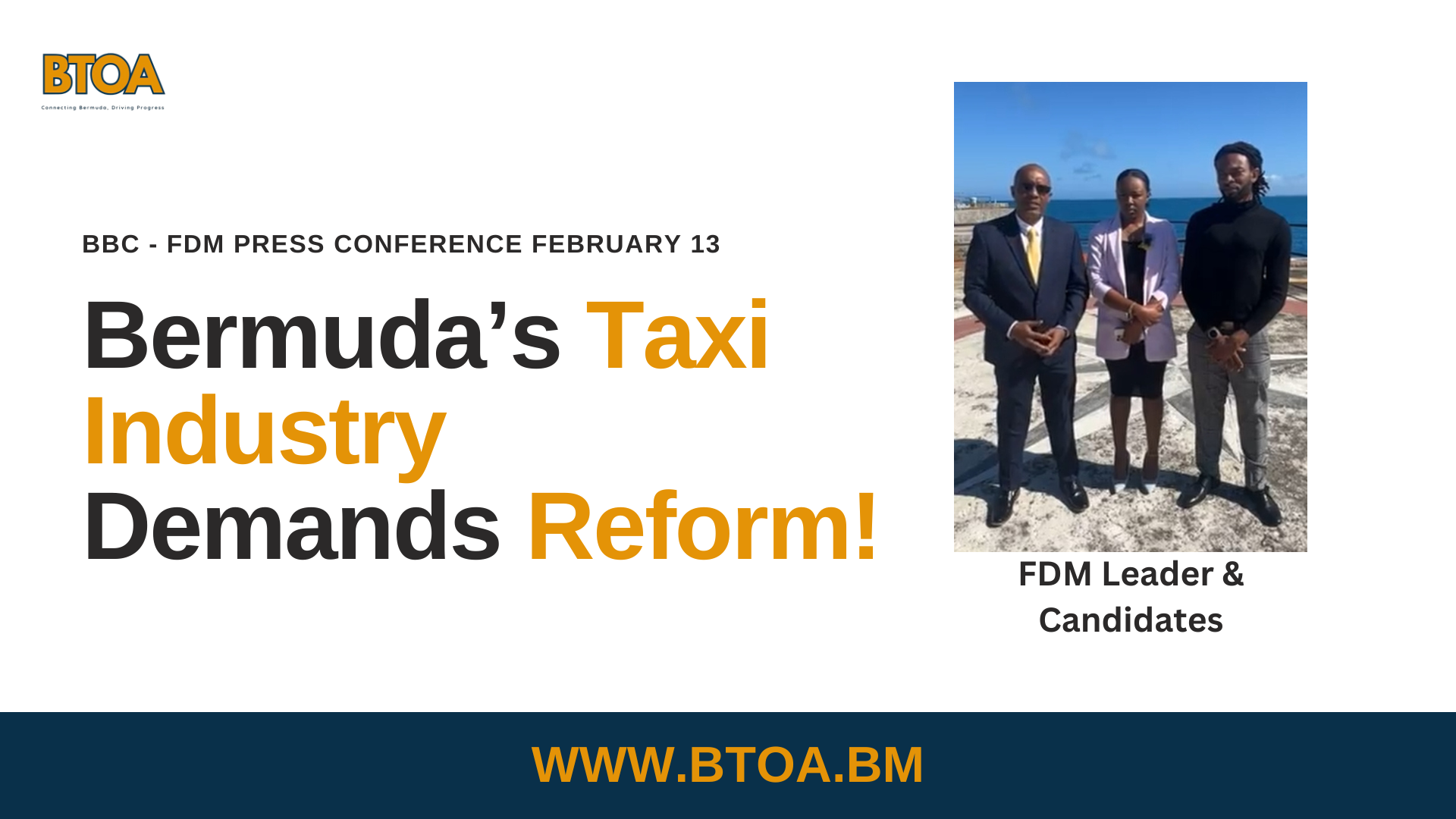
The Bermuda Taxi Owners and Operators Association (BTOA) has raised substantive concerns following the Government’s tabling of amendments to the Motor Car Act, which would introduce 150 seasonal, app-based public service vehicles into the transport system.
The proposal, announced by the Minister of Transport, seeks to expand capacity between April and September through ride-share style operations. However, the BTOA maintains that the policy direction is being advanced without the necessary evidentiary foundation to justify such a significant structural change.
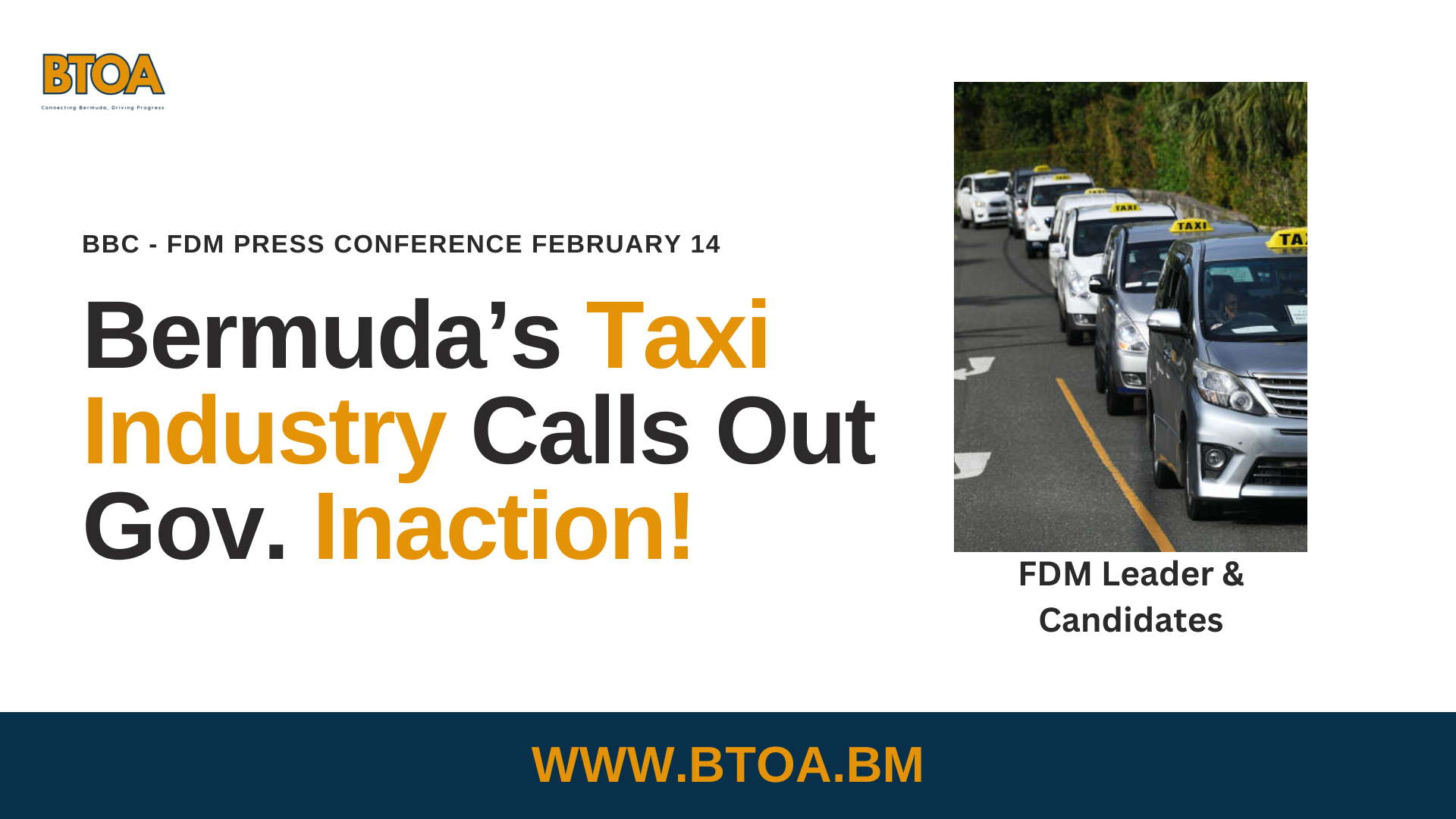
Speaking in a recent interview with Bermuda Broadcasting, covered by the BBC, industry representatives emphasized that the issue is not opposition to innovation, but the absence of data-driven justification.
BTOA Raises Evidence Gap Concerns Over Proposed Ride-Share Expansion
Taxi industry calls for data-driven policy as the government advances 150 seasonal ride-share vehicles without a published impact analysis
“We are not saying no to innovation, no to progress, or no to improvement. We are simply saying: take a stop and look at what data we actually have, so that policy decisions are evidence-based.”
The Association’s position is consistent with its broader policy framework outlined in its official transport policy statement, which can be reviewed here: https://btoa.bm/btoa-transport-policy-statement-bermuda/
Policy Without Data: A Structural Risk
At the core of the BTOA’s position is a fundamental governance concern: the absence of a publicly presented needs assessment or transport system analysis.
During the interview, it was highlighted that no current dataset has been provided to demonstrate:
- unmet demand within the existing taxi system
- peak service gaps or failure rates
- customer complaint trends tied to availability
- measurable inefficiencies requiring market expansion
“If there was data provided to say these are the weak points of the industry… but there is no data.”
This absence raises a critical policy question: whether the proposed expansion is addressing a verified service deficiency or introducing additional supply without diagnosing the root issue.
Existing Data Infrastructure Already Available
A key point raised by the BTOA is that the Government may not need to create new systems to obtain this analysis. The data already exists within Bermuda’s current taxi dispatch ecosystem. Modern taxi platforms, including Journi, Hitch, and Ride.BM dispatcher systems capture detailed operational metrics such as:
- driver login activity
- job acceptance and completion rates
- cancellations and failed trips
- customer wait times
“The Minister does not need to create anything. He just needs to collect the data and apply what is already within the law.”
The Association has indicated that, to its knowledge, this data has not been systematically collected or analysed by the Transport Control Department (TCD) to inform policy decisions.
Enforcement vs Expansion
Another central concern is that longstanding enforcement gaps remain unaddressed. The BTOA argues that before introducing new operators into the system, the Government should ensure compliance within the existing licensed fleet.
This includes:
- adherence to service obligations
- consistent availability across peak demand periods
- enforcement of licensing standards
Â
The concern is that adding a new class of operators particularly one operating under a different regulatory and operational framework could further fragment the industry without resolving underlying inefficiencies.

Government Position and Market Framing
During the same interview, the programme host, Gary Foster-Skelton, raised the question of whether the proposal simply introduces competition into a traditionally regulated market:
“Isn’t that just bringing some competition… into a traditionally closed space?”
While acknowledging that competition itself is not inherently problematic, the BTOA maintains that policy design must be grounded in evidence rather than assumption.
“We don’t see an issue with the concept of competition… but the first thing we need to address is what data proves this solution will improve the system.”
Outstanding Questions
The Association has confirmed that repeated requests for data and impact assessments over the past two years have not resulted in substantive disclosure.
Key unresolved issues include:
- Whether a formal transport impact assessment has been conducted
- What historical or current data underpins the proposed expansion
- How will the effectiveness of the 150 seasonal vehicles be measured
- whether existing digital dispatch data has been utilised
The BBC report further notes that previously presented data in Parliament was limited in scope and did not include key performance indicators such as response times or cancellations.
A Call for Measured, Evidence-Based Reform
The BTOA continues to advocate for a collaborative, data-led approach to transport reform in Bermuda. The Association’s position is clear: modernization is necessary, but must be structured, transparent, and grounded in verifiable evidence.
The introduction of new service classes without this foundation risks unintended consequences for service quality, regulatory balance, and industry sustainability.
As the legislative process continues, the BTOA is calling on policymakers to pause, engage stakeholders meaningfully, and ensure that any reforms are informed by comprehensive and transparent data analysis.